About Sikhism
SIKHISM -The Religion of Thought and Action
Every business is unique, and so are our solutions. Here’s how we tailor our expertise to your needs

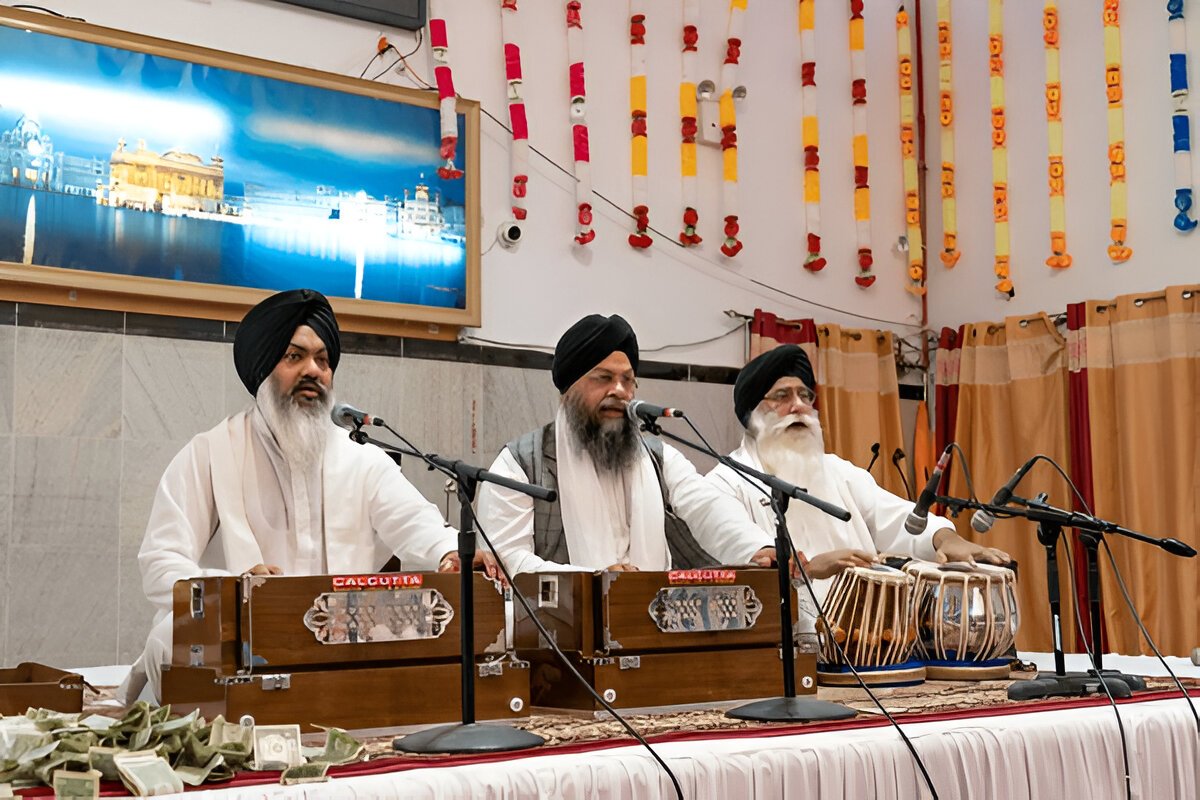
The austere color of saffron fluttering high in the breeze. Framed against the lofty indigo of the sky. The Nishan Sahib (religious flag staff), standing , proud, in front of shrines that glow in marble splendour. The air is rent with the tunes of the shabads (devotional hymns) and the passages read from the Guru Granth Sahib (the holy book of the Sikhs). There is a sense of tranquility that flows into one as soon as one enters the Gurudwara (the Sikh house of prayer). Hands folded in devotion, hands having just held the warmth of the karah parsad (a sacred offering consisting of flour, sugar and ghee made for the God and then distributed to all who visit the Gurdwara). Heads bowed in silent prayer and in awe at the beauty of it all.

The Birth of Guru Nanak
The birth of Guru Nanak (near Lahore in present Pakistan) in 1469,heralded the origin of Sikhism. When a new religion is born, it consists of a plethora of philosophies and thoughts that it accepts, rejects and adds to from various other religions. Born and bred amidst Indian soil and culture, Sikhism shared certain facets with other religions but also differed in many respects.
It maintained a separate and distinct identity with its own line of traditions, but upheld all other religions and faiths with equal respect. It was Guru Nanak who gave the religion of Sikhism its monotheistic identity. It is he who coined the mul mantra (the key prayer): ‘IK ONKAR’ (God Is One), ‘SATNAAM’ (Truth his Name), ‘KARTA PURAKH’ (He is the Creator), ‘NIRBHAU’ (He is without fear), ‘NIRVAIR’ (He is beyond birth and death- The Enlightened One), ‘GUR PARSAAD’ (He can be known by the Guru’s Grace ). It is the prayer that explains the entire concept of this religion. It is this unitary nature of God that the very core of the Sikh school of thought.
The Creation of Khalsa
Chidya naal main baaz ladava,
Tabhi Guru Gobind Singh naam kahawa
(I will make the sparrows capable of fighting the hawks, for it is only then that i will be able to uphold my name.)

Hence on the 30th day of march in the year 1699, Gobind Singh created the ‘Khalsa’ (the pure); from a gathering that he was addressing at Anandpur Sahib, he selected five people whom he believed to be fearless in spirit and called them the ‘Panj piare’ (the five beloved ones). Thus was born the Khalsa and the panj piaras formed its first order. Guru Gobind Singh then himself, was inducted into the order by the newly baptized, thus equating himself with the Khalsa. He also instructed the Khalsa to wear five symbols which would distinguish them as such. These five symbols beginning with the letter ‘k’ kirpan (sword), kesh (long hair), kangha (comb), kara (steel wristband), kacch(shorts). Ever since then , the number five has assumed a religious significance. In addition to the wearing of five symbols, the Khalsa men would also have to add the word ‘Singh’ (lion) to their names not only to impart a sense of bravery but also to equate the status of each and everyone and do away with the caste names.
The Sikh Approach Towards Life

The Sikh approach to life is not that of self-with drawl but that being very much a part of social life and doing one’s duty. It was during the the time of Guru Ram Das that the virtue of naam japna (remembering the divine name), kirat karna (earning a living through honest means) and wand chakna (sharing one’s earnings with the needy) were nurtured. These were the virtues which according to the Guru, constituted ideal Sikh conducted and thee could only be incorporated while one was a part of society. Hence, the community holds prime importance in Sikhism as it is a religion that has its principles deeply rooted in the social set up.
The Virtue's

The first virtue of Nam japna or the recitation of the name of God can be done when one is alone but is encouraged through sangat (congregation). Kirtans (devotional hymns set to the tune of certain ragas), a way of chanting the name of Waheguru (the Almighty), evoke the best response in one’s self when sung in sangat. The role of sangat has been highlighted in the Sikh tradition and emphasizes the need for social involvement and commitment. It is an ideal medium for inspiring the individual to participate in social life as a member of an ideal social unit. The second of these virtues is that of Kirat Karna which tells a Sikh to do honest labour without exploiting anyone. The third virtue , Wand Chhakna, encourages the Sikh to share with other what is earned through honest means. This incorporate the principles of daswandh and langar. Daswandh, literally means one-tenth of one’s income and a true Sikh is supposed to donate the amount . Since not all Sikh can donate that much, they give whatever they can. Even a single rupee is worth a million when it has been earned of honest labour.
Langar (the community kitchen which feeds everyone free of cost) is yet another way of sharing amongst the community. It is a feeling that binds all irrespective of caste, creed and color. Sikhism has been coined as a religion of ‘spirit’ – one that stresses not only on the relationship between man and God but also on the importance of relationship amongst mankind. It believes in equality of people and hence makes no distinction between caste, creed, color or gender. The concept of langar, which requires people to sit and eat together, strengthens this belief. In fact, this virtue which was nurtured by Guru Ram Das has been given utmost importance. As the saying goes:

The Langar Community
Langar (the community kitchen which feeds everyone free of cost) is yet another way of sharing amongst the community. It is a feeling that binds all irrespective of caste, creed and color. Sikhism has been coined as a religion of ‘spirit’ – one that stresses not only on the relationship between man and God but also on the importance of relationship amongst mankind. It believes in equality of people and hence makes no distinction between caste, creed, color or gender. The concept of langar, which requires people to sit and eat together, strengthens this belief. In fact, this virtue which was nurtured by Guru Ram Das has been given utmost importance. As the saying goes: